Climate risk is already in your supply chains, your insurance premiums, your facility exposures, and your investor questions. KERAMIDA helps you map the full picture, quantify the financial impact, and turn climate uncertainty into an informed strategy.
A Different Kind of Climate Risk Assessment
Most climate risk assessments are delivered as finished reports, forcing your audit committee to defend numbers that they cannot trace. KERAMIDA builds the analysis with your team, so the rationale behind every rating is something your people understand and can explain.
For organizations fielding questions from lenders, insurers, or investors, a defensible, externally communicable climate risk assessment is increasingly a commercial requirement, not just a reporting one. KERAMIDA's documentation standards are designed with that audience in mind.
Climate Advisory Services
Climate-Related Risks & Opportunities Assessment
Before a company can manage its climate risks, it needs a clear, documented picture of what those risks are, how well it currently understands them, and what it is already doing to control them. This assessment captures that baseline. It surfaces the organization's existing understanding of the climate-related risks and opportunities it faces, together with the controls and actions already in place to manage them. That current-state snapshot becomes the foundation for prioritizing action and tracking progress over time.
What Scope Is Right for Your Organization?
Most clients benefit from a combined assessment, but the right scope depends on your business model and exposure profile.
Physical-focused Climate Risk Assessment: Often right for manufacturers, industrial operators, and organizations with significant geographic asset concentration, where flood, heat, drought, or extreme weather poses direct operational risk.
Transition-focused Climate Risk Assessment: Often well-suited to service-sector companies, technology firms, and organizations whose primary exposure is to regulatory, market, and supply-side changes rather than direct physical impacts.
Combined Climate Risk Assessment: Provides the most complete picture and is typically required under IFRS S2 and ESRS E1. It is also the appropriate scope for organizations preparing a Climate Transition Plan.
Most engagements begin with a one-hour scoping conversation to define boundary, timeline, and disclosure requirements.
KERAMIDA's assessment follows three steps:
Identification: We benchmark against sector peers and the latest climate science to build a long list of potential physical risks (acute and chronic), transition risks (policy and legal, technology, market, and reputational), and climate-related opportunities. This captures the organization's current understanding of each risk, what is already on its radar and how it is perceived, and maps each to the transmission channel through which it flows into financial exposure.
Assessment: We gather data to define the scope and exposure of each risk and opportunity, and evaluate the controls already in place to manage them. This distinguishes gross (inherent) risk from residual risk after accounting for existing mitigations and identifies where current controls are adequate and where gaps remain.
Prioritization: We evaluate each risk and opportunity by likelihood and residual impact across relevant time horizons, highlighting where action is most needed.
Assessment Deliverables:
Each assessed risk or opportunity is documented with:
Risk/opportunity description and category (physical, transition, or opportunity)
Transmission channel into financial risk
Inherent likelihood and impact, with time horizon
Current controls and actions already in place
Assessed effectiveness of those controls
Residual risk after existing controls
Enterprise Risk Management (ERM) Integration
KERAMIDA structures engagements so the outputs integrate cleanly into your existing enterprise risk management framework, including risk registers, board reporting, business continuity planning, and capital allocation processes.
Climate Scenario Analysis (CSA)
Once an organization has a general understanding of the climate risks it faces, scenario analysis takes a deeper look at how those risks could play out. Climate scenario analysis evaluates how climate-related risks and opportunities might unfold under a range of plausible futures, across business-relevant time horizons.
The outputs help organizations:
Update risk registers and strengthen board reporting
Inform investment and capital allocation decisions
Adjust strategy, targets, and resilience planning
Support investor, lender, and regulator engagement
Meet TCFD, IFRS S2, SB 261, and climate disclosure requirements
KERAMIDA’s CSA Process:
Our process is built around workshops with your team rather than a black-box model, and produces defensible, traceable outputs aligned with TCFD, IFRS S2, and ESRS E1 expectations. KERAMIDA conducts both physical and transition risk scenario analyses using a structured four-step process:
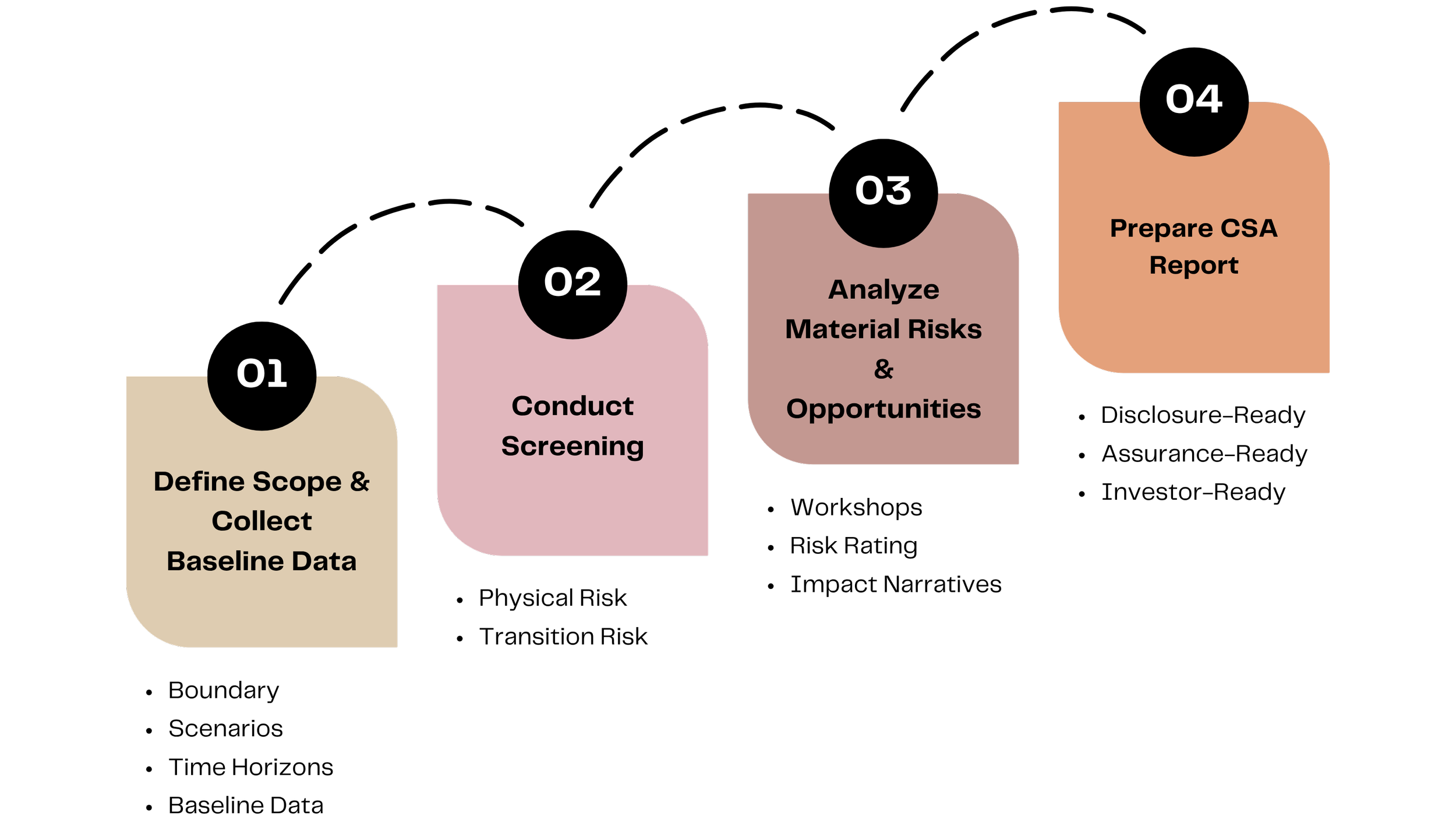
Define Scope and Collect Baseline Data
We begin with a kick-off workshop to establish the analytical foundation: defining the boundary (owned and leased sites, or extended value chain), selecting scenario pathways, establishing time horizons (short, medium, and long term), and collecting the physical and transition risk baseline data the analysis will draw on.
Conduct Screening
Physical risk screening uses software to generate site-specific exposure data across each scenario and time horizon. Assets are segmented by group (regions, upstream suppliers, logistics routes) and narrowed to identify those with the highest exposure. Transition risk screening draws on published and internal research to assess materiality across in-scope assets.
Analyze Material Risks and Opportunities Across Scenarios
KERAMIDA facilitates cross-functional workshops with your operations, risk management, sourcing, finance, and sustainability teams to:
Ground-truth exposure data with site-specific knowledge and real-world resilience factors that your internal teams recognize
Assign impact and uncertainty ratings for each time horizon and scenario pathway
Develop an overall risk rating that combines exposure, vulnerability, impact, and uncertainty into a prioritized, financially material view
Build impact narratives for priority risks, which form the basis for financial quantification
Prepare CSA Report
We use the analysis to produce a disclosure-ready CSA report that your assurance provider can validate and your board can present to investors without qualification. The report is structured to meet the documentation requirements of the frameworks your organization must comply with.
CSA Deliverables:
Clients receive a CSA report that includes:
Clearly documented scope, data sources, and assumptions
Defined screening criteria and prioritization logic
Material risks and opportunities mapped by time horizon and scenario
Traceable risk ratings, ready for assurance and audit
Scenarios, assumptions, uncertainties, and potential financial implications outlined
Disclosure Support: TCFD, IFRS S2, ESRS E1, SB 261, and CDP

KERAMIDA structures Climate Scenario Analyses to support the disclosure requirements your organization faces, whether voluntary (TCFD, CDP) or mandatory (IFRS S2 in jurisdictions that have adopted ISSB standards, ESRS E1 under the EU CSRD, California SB 261, and emerging SEC requirements).
The underlying analysis is the same across frameworks. What changes is the documentation, disclosure elements, and regulatory framing we prepare alongside it.
California SB 261: For companies doing business in California, SB 261 requires biennial climate-related financial risk reports, and a rigorous CSA is the evidentiary foundation of a defensible submission. See KERAMIDA's California SB 261 Consulting services.
For clients preparing their first IFRS S2 submission, a CSA provides the underlying evidence base. For clients already disclosing under TCFD or CDP, it strengthens existing disclosures with updated data, expanded scope, or deeper financial quantification. Disclosure readiness is a byproduct of doing the analysis well, not a goal that shapes the analysis itself.
Double Materiality Assessment (EU CSRD / ESRS)
For clients subject to the EU Corporate Sustainability Reporting Directive (CSRD), climate disclosure requires a double materiality assessment that evaluates both how climate change affects your business (financial materiality) and how your business affects the climate (impact materiality).
KERAMIDA works with clients to structure CSAs that integrate into a broader double materiality process, supporting ESRS E1 disclosure alongside CSA outputs. For clients whose CSRD obligations extend through EU customer or parent-company requirements, we help define the appropriate scope.

Climate Transition Plan (CTP)
When a Climate Scenario Analysis is combined with a Decarbonization Plan, the result is a Climate Transition Plan (CTP), a forward-looking document that addresses both how your organization will reduce emissions and how it will manage the physical and transition risks of a changing climate. KERAMIDA delivers CTPs aligned with TCFD recommendations, IFRS S2, and the TPT Disclosure Framework now maintained by the IFRS Foundation.
For organizations facing significant external pressure from investors, regulators, or customers, or those required to publish transition plans under SBTi's updated Corporate Net-Zero Standard V2.0, the CTP is the appropriate level of rigor.
Featured Climate Risk Advisory & CSA Projects:


KERAMIDA is conducting a quantitative Climate Scenario Analysis for this Tech Client to support compliance with CA SB 261. The Client is an industry-leading technology company that designs and develops high-performance semiconductor and silicon IP products that advance data center connectivity. KERAMIDA is investigating the impacts of physical climate risks on the Client's main locations.

ED&F Man Commodities is one of the world’s leading providers of soft commodities with a range of products, including sugar, coffee, molasses, animal feed, and fish oils. KERAMIDA assisted ED&F Man with its inaugural TCFD disclosure and with the development of three individual Climate Action Plans for each of its Divisions: ED&F Man Liquid Products (MLP), ED&F Man Sugar, and ED&F Man Volcafe.
What our clients say:
“We want to express our gratitude for the collaborative effort from KERAMIDA throughout this journey. It has been a rewarding experience working together. Looking forward to more successful collaborations in the future.”
Why Partner with KERAMIDA?
-
Financial quantification is a scoped capability in every engagement. When included, it transforms climate risk from a sustainability conversation into a capital allocation conversation, and gives your CFO, lenders, and board something they can act on. Our quantification methodology is documented for audit and assurance readiness: every number traces back to its underlying assumptions and data sources.
-
The core of KERAMIDA's methodology is a structured impact-times-uncertainty rating framework: a transparent, repeatable way to rank climate drivers that your audit committee can scrutinize and your assurance provider can validate. Every rating, ranking, and driver research source is documented and traceable, making the analysis defensible to regulators, auditors, and stakeholders. Most platform-driven tools publish a risk score and keep the model proprietary. We do not.
-
Our process is organized around workshops with your operations, risk management, business continuity, sustainability, and leadership teams rather than running a model and presenting results at the end. That approach surfaces exposures your internal teams already recognize, builds organizational alignment around the findings, and produces outputs your people can explain, not just reference.
-
Our Climate Scenario Analysis process follows the TCFD framework, now maintained by the IFRS Foundation, and is informed by Haigh's Scenario Planning for Climate Change, a foundational academic methodology for corporate scenario analysis. We stay current with the evolving requirements of IFRS S2, ESRS E1, California SB 261, CDP, and emerging SEC climate disclosure rules, so your analysis aligns with the standards your stakeholders and regulators expect now and in the near term.
-
KERAMIDA has delivered climate risk assessments and scenario analyses for global manufacturers, regional industrial clients, and municipalities. That cross-sector track record means we bring benchmarks, methodology precedents, and sector comparisons to every engagement. Our climate risk work also builds directly on KERAMIDA's capabilities in GHG accounting, decarbonization planning, and sustainability reporting, so the analysis connects to the strategic actions that follow it, without hand-offs between firms.
Recommended Insights:








Related Services: