
Your SBTi Target Is Set. Here's How to Actually Achieve It.
/
As of January 2026, more than 10,000 organizations have validated science-based targets with the Science Based Targets initiative (SBTi). For many companies, this was a significant undertaking driven by customer requests, investor scrutiny, and growing market pressure. However, while setting a target is no easy feat, many organizations are left with the more difficult question: what comes next?
What Are Science-Based Targets?
Science-based targets are specific goals set by companies to reduce their greenhouse gas (GHG) emissions by a given amount in a given time frame aligned with the latest climate science. Committing to a target through SBTi is public, and progress against it can be scrutinized by investors, customers, and other stakeholders. Failing to make meaningful progress or achieve the target carries reputational and financial risks. For many companies, there is a clear tension between the target they have set and the path to achieve it.
Why Is Implementation So Hard?
To establish an SBTi target, companies often develop high-level reduction plans focused on major emission sources and common decarbonization levers, such as renewable energy procurement, electrification, and efficiency improvements. While these plans may support the target on paper, they are often abstract. They lack operational detail and may not have been developed considering real-world factors such as budget cycles, technology limitations, and organizational siloes. When viewed from the other side of the commitment, it becomes much harder to understand how the target will be achieved.
Turning a Near-Term Climate Target into Concrete Action
For companies with 2030 or similar targets, the timeline to act is already short. What does increasing your company’s share of renewable energy actually mean? Should you pursue power purchase agreements (PPAs), stay flexible with energy attribute certificates (EACs), or invest in some rooftop solar? How much is needed, and when? Who in the company will make sure it happens? Without clear answers to such questions, even well-supported targets can be difficult to execute. This is where many high-level plans fall short.
Bridging this gap requires more than moving directly from target-setting to implementation. It requires translating high-level strategy into a structured roadmap that defines what actions are needed, when they must occur, and how they will be carried out in practice. Only once that roadmap is clearly established can it be broken down further into specific, actionable initiatives that can be implemented across the organization.
From Forecast to Pressure-tested Roadmap
How to Build a Decarbonization Roadmap That Actually Works
While a thorough decarbonization roadmap is ideally developed before setting targets, many companies set targets first and develop decarbonization strategies later; in these cases, the first step is establishing a company-wide roadmap that moves beyond high-level assumptions and defines a realistic path to implementation.
In the section below, we’ve laid out a six-step roadmap grouped by the horizon where the work concentrates: diagnosis up front, decisions in the middle, and defensibility at the end. Depending on the work done prior to SBTi submission, companies may start from Step 1 or pick up partway through. However, even steps that appear complete are worth revisiting, as earlier assumptions can affect everything that follows.
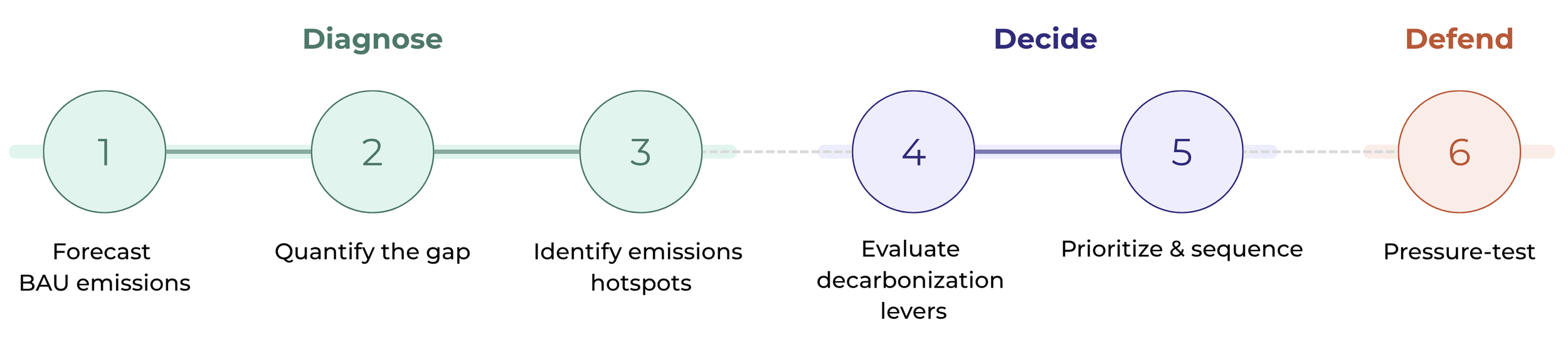
Diagnose
Many companies spend years refining how they track emissions and become so focused on improving data collection and calculation methods that they often miss what their data actually shows.
Any company with a GHG inventory can complete the three steps in the “diagnose” phase, which evaluates where emissions are concentrated and how they are likely to change over time. As inventory maturity and methodologies evolve, these steps can be honed to even greater levels of detail. Understanding where the problem lies is key to finding the right solutions and putting together a truly actionable decarbonization roadmap.
STEP 1: Forecast business-as-usual emissions
Action: Use the existing GHG inventory and develop a business-as-usual (BAU) forecast that reflects expected growth, asset changes, and evolving grid emissions.
Explanation: Present-day emissions don't tell the whole story. Considering factors such as global trends, the company’s trajectory, and key upcoming strategy decisions is crucial to constructing a roadmap that addresses the emissions not just of today, but also tomorrow.
STEP 2: Quantify the gap
Action: Compare projected emissions with stated targets to determine the scale and timing of the required reductions.
Explanation: Baseline emissions show what to expect, but comparing them against your commitments reveals the true magnitude of reductions needed. Quantifying that gap makes it clear exactly what you need to achieve, and by when.
STEP 3: Identify emissions hotspots
Action: Map emissions across scopes, categories, and activities to focus efforts on the most important sources.
Explanation: You can't decarbonize effectively by focusing effort where little reduction opportunity exists. Identifying which emission sources dominate your operational footprint ensures resources are directed where they matter most.
Decide
The “decide” phase is the most important, as it involves evaluating and ordering your options. Examining key factors such as cost, emissions-reduction potential, implementation timeline, and more provides insight into the true cost of each option.
Companies frequently face obstacles during this phase, including data limitations and decision overload. Getting it right requires that a company have a robust GHG inventory and evaluate options at the proper level of depth.
STEP 4: Evaluate decarbonization levers
Action: Identify each lever, along with its associated emissions-reduction potential, feasibility, and cost, so that trade-offs are explicit, not implied.
Explanation: Every emissions source has different reduction options available, each with its own strengths and tradeoffs. Exploring them thoroughly will help you determine what works best for your organization.
STEP 5: Prioritize and sequence
Action: Order initiatives across near-, medium-, and long-term horizons based on feasibility, dependencies, and capital planning.
Explanation: Every organization faces constraints on decarbonizing immediately, whether financial, resource-related, timing-related, or strategic. By prioritizing and sequencing, you stay focused on what matters most now while keeping future actions on your radar.
Pro Tip: KERAMIDA recommends using a Marginal Abatement Cost Curve (MACC), the best tool on the market for ensuring you achieve high-impact reductions in the most cost-effective way.
Defend
Once a company has diagnosed its inventory and decided on its decarbonization options, the work isn't done. Defending your roadmap means re-evaluating selected initiatives against the BAU projections from Step 1 to confirm that the outlined process is sufficient to meet your targets across a range of possible futures.
STEP 6: Pressure-test
Action: Test the roadmap against real-world constraints so it is actionable, defensible, and aligned with how the organization actually operates.
Explanation: A roadmap that holds up in one scenario may fall apart in another. Testing against varying conditions, such as policy shifts, energy price changes, or operational disruptions, is what separates a plan that looks good on paper from one you can effectively execute.
A decarbonization roadmap defines the path forward, but it does not ensure progress on its own. The next stage is translating that roadmap into specific actions that can be executed across the organization.
From Roadmap to Results
How to Move From Roadmap to Full Implementation Plan
Once a company has developed its organization-wide roadmap, the next step is translating it into an implementation plan that breaks the strategy into specific, actionable initiatives at the facility, department, or asset level.
A decarbonization roadmap defines what needs to happen; an implementation plan defines how it will be delivered in practice. For companies of sufficient size, this often begins with representative assets or sites, where detailed assessments can identify opportunities scalable across the organization. Without this level of detail, even well-supported strategies can struggle to gain traction.
Below are the six elements every decarbonization implementation plan must address:
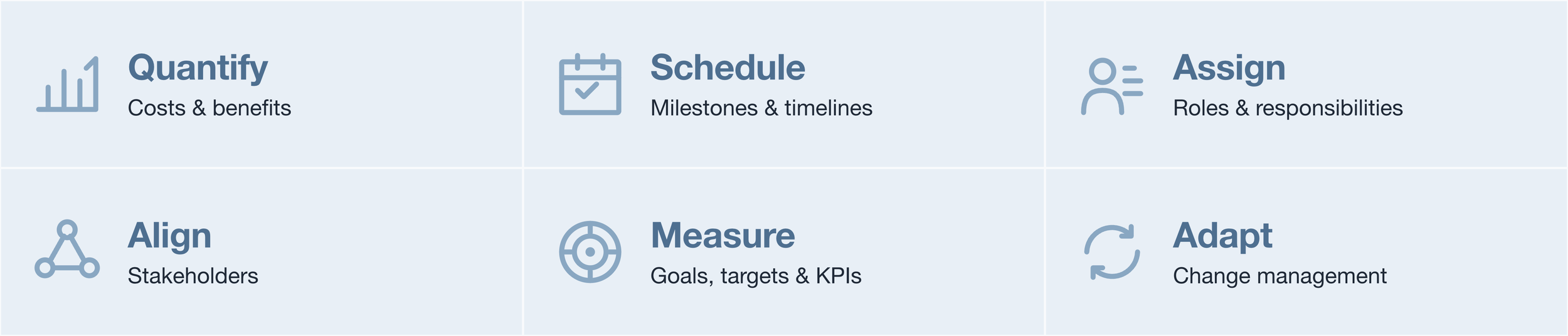
Quantifying costs and benefits early prevents surprises later and gives decision-makers a clear basis for prioritization. Milestones and timelines turn intentions into commitments. Defined roles eliminate the ambiguity that stalls execution, and stakeholder alignment ensures the right people are engaged before obstacles arise. Without measurable goals and KPIs, progress becomes difficult to track and even harder to defend. And because conditions rarely stay static, building in change management from the start is what allows a plan to hold up over time.
Without addressing these elements in depth, plans often remain theoretical, and organizations tend to overestimate progress. Decarbonization does not occur simply because a target is set or a roadmap is developed. It depends on translating strategy into action and following through with disciplined execution. Companies that do this effectively are able to identify constraints early, align internal stakeholders, and build pathways that are both credible and achievable.
If you have set an SBTi or another emissions-reduction target but are still determining how to operationalize it, KERAMIDA can help. We offer a complimentary Decarbonization Plan Diagnostic, which uses company-provided information to identify initial gaps and opportunities in your roadmap and execution approach. To learn more or get started, contact us or call (800) 508-8034 to speak with one of our decarbonization experts.
Author

Kendra Roesner, MPA-MSES
Manager, Sustainability
KERAMIDA Inc.
Contact Kendra at kroesner@keramida.com
Related Services


KERAMIDA develops GHG emissions inventories that are accurate, defensible, and ready for investor and regulatory scrutiny. We quantify Scope 1 (direct), Scope 2 (purchased energy), and Scope 3 (value chain) emissions using the best available organizational data and acceptable methodologies as defined by the GHG Protocol. Whether you have detailed primary data, utility bills, fuel usage records, procurement spend, or supplier-provided estimates, our team can work with what is available to create a complete and transparent accounting of your emissions inventory.