
A Step-by-Step Guide to SB 253 GHG Reporting
/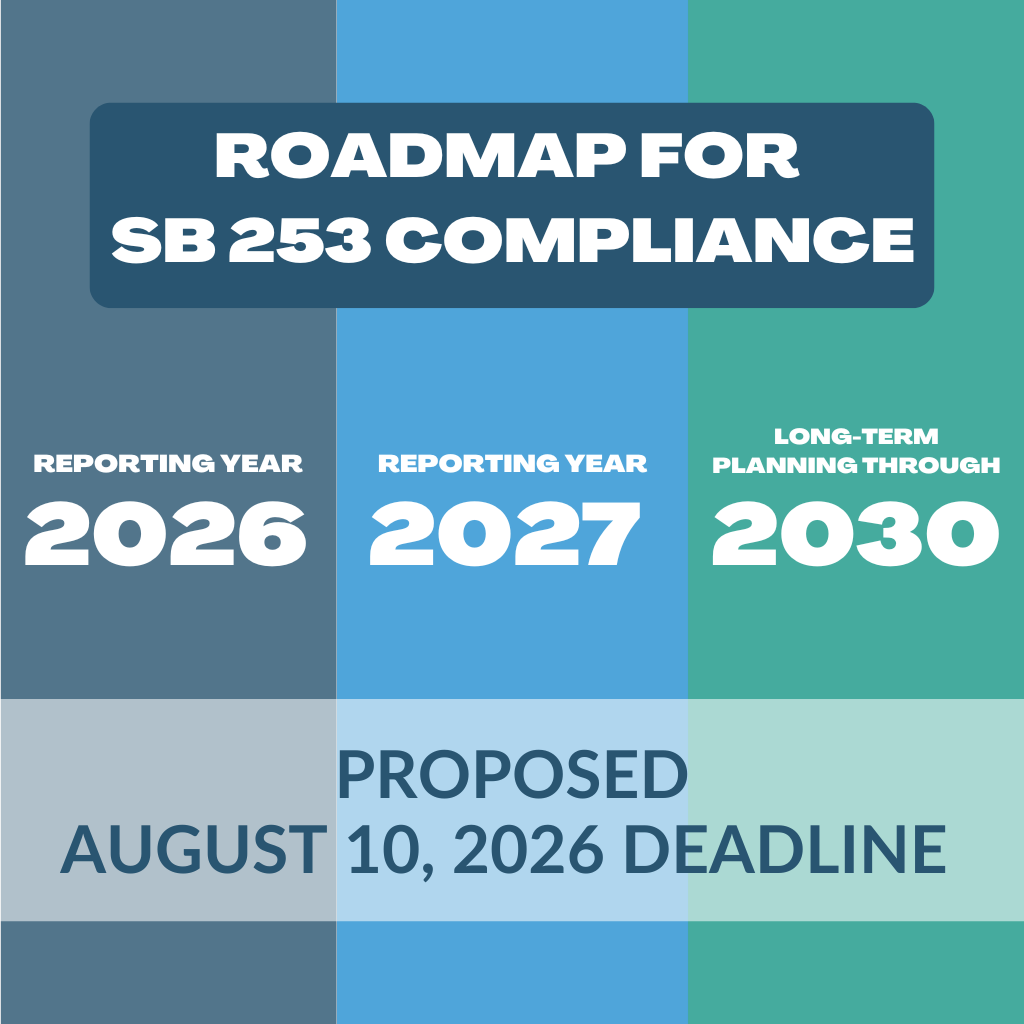
California’s Climate Corporate Data Accountability Act (SB 253) continues to evolve, and CARB’s latest proposed updates, shared during the November 18 workshop, provide clearer guidance on who must report, what data must be included, and how companies should prepare for upcoming deadlines. The detailed, easy-to-follow roadmap at the end of this article incorporates CARB’s most recent proposed changes to help companies understand their obligations, develop an actionable plan for compliance, and meet the new proposed deadline of August 10, 2026, for the first SB 253 reports.
Current SB 253 Requirements
Who must comply with SB 253?
U.S.-based corporations, partnerships, and LLCs with over $1 billion in annual revenue and that are "doing business in California" (as determined using Revenue and Tax Code 23101).
CARB has released a draft preliminary list of approximately 4,160 companies that may fall under the disclosure requirement.
What must be reported?
Scope 1: Direct emissions from owned or controlled sources (e.g., boilers, vehicles, refrigerants).
Scope 2: Indirect emissions from purchased electricity, steam, heating, or cooling.
Scope 3: All other indirect emissions across the value chain (supply chain, logistics, product use, waste, etc.).
What type of data should be included?
CARB has released a draft SB 253 Scope 1 & 2 reporting template.
The template is voluntary for 2026, but it signals the data CARB intends to require going forward.
When is the deadline?
2026: Annual reporting begins for Scope 1 (direct emissions) and Scope 2 (purchased energy emissions).
Proposed deadline: August 10, 2026.
2027: Scope 3 reporting begins.
What data needs to be verified?
2027-2029: Limited assurance required for Scope 1 & 2
2030: Reasonable assurance required for Scope 1 & 2.
Scope 3: Limited assurance starting no later than 2030.
Where are reports filed?
Reports will be submitted to CARB under the new California Corporate GHG Reporting Program.
Reported data will be publicly available.
What are the penalties?
CARB may issue penalties of up to $500,000 per reporting year for violations (non-reporting, late reporting, or inaccurate submissions).
For the first reporting cycle in 2026, CARB will not penalize good-faith efforts to report Scope 1 and Scope 2 using available data.
SB 253 Compliance Roadmap
How can a company prepare? Below are 8 steps that a business can follow to ensure it is prepared to comply with SB 253 by the August 10, 2026, deadline, and beyond:
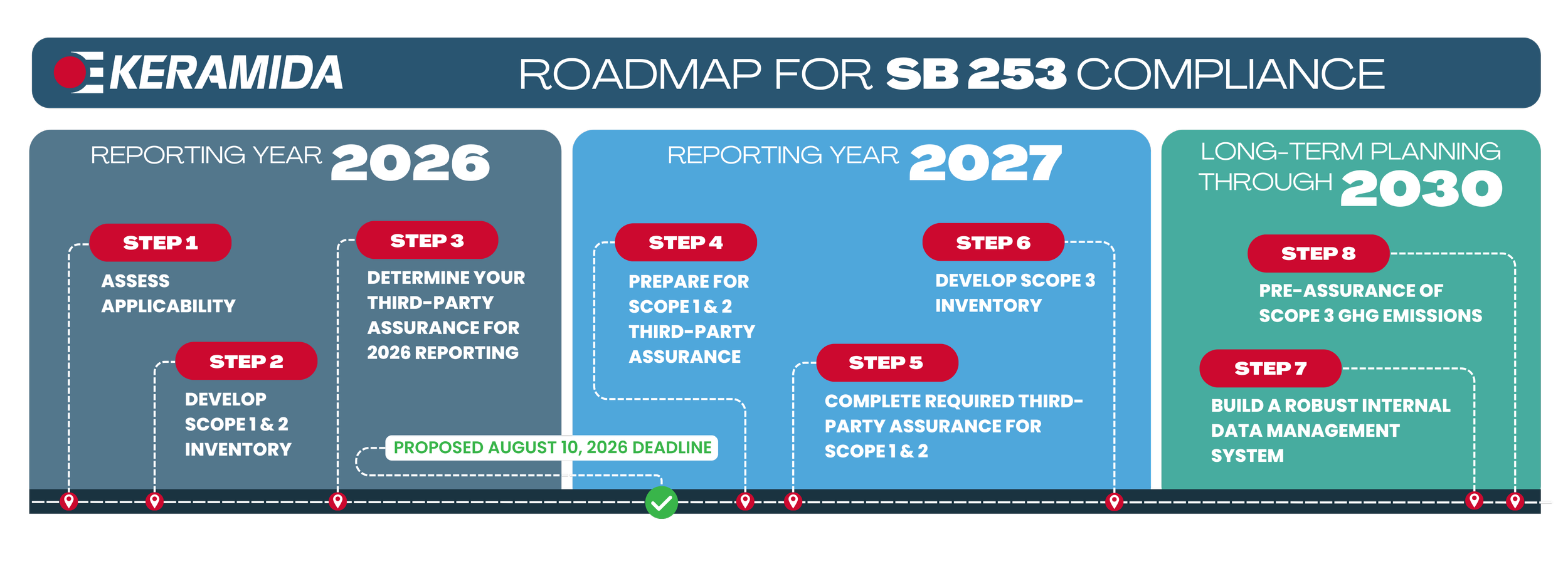
Reporting Year 2026
STEP 1: Assess Applicability
Confirm revenue thresholds.
Determine whether you are “doing business” in California.
Reference the CARB Preliminary List of Reporting
Review possible exemptions.
STEP 2: Develop a Scope 1 & 2 Inventory
Define your organizational boundary (operational control, financial control, or equity share).
Identify emissions sources: electricity, natural gas, fuel use from backup generators, fuel usage from fleet, process emissions, refrigerants, etc.
Collect activity data such as invoices, purchase records, and landlord surveys.
Compile activity data into a digital format.
Conduct quality checks and fill gaps in accordance with the GHG Protocol.
Calculate GHG emissions using emission factor sources such as eGrid, EPA Hub, DEFRA, and IEA.
Account for RECs and on-site renewable energy appropriately.
Develop an Inventory Management Plan (IMP) that documents boundaries, data collection methods, calculations, and assumptions.
STEP 3: Determine Your Third-Party Assurance for 2026 Reporting
Third-party limited assurance is currently not required for 2026 submissions (but will be mandatory beginning in 2027). (See CARB’s latest updates on this requirement.)
As all CARB-reported data will be publicly accessible, pursuing voluntary assurance of Scope 1 and Scope 2 GHG emissions can enhance credibility with stakeholders, identify potential data gaps, and support preparation for the 2027 mandatory assurance requirements.
If cost or timeline is a concern for third-party assurance, consider pre-assurance. Talk with your assurance provider to see if this is recommended based on your data status.
Reporting Year 2027
STEP 4: Prepare for Scope 1 & 2 Third-party Assurance
Keeping your IMP well-documented and your data centralized will make the assurance process much more efficient.
If your organization is new to third-party assurance or is concerned about meeting the timeline, consider conducting pre-assurance using historical data to ensure your methodologies are aligned.
STEP 5: Complete Required Third-Party Assurance for Scope 1 & 2
Engage an accredited assurance provider early, and confirm the timeline and process upfront to ensure you meet required deadlines.
Choose a provider that can deliver reasonable assurance by 2030 and has experience with Scope 3 assurance to avoid future transitions.
STEP 6: Develop Scope 3 Inventory
Use the same organizational boundary applied for Scopes 1 and 2, and determine which of the 15 Scope 3 categories are relevant to your operations. Reference GHG Protocol Scope 3 Accounting and Reporting Standard.
Leverage internal resources to identify available data that can support GHG calculations for relevant Scope 3 categories. Develop an inventory development plan outlining your calculation methodologies, data sources, and major assumptions to be made. It’s common to start with spend-based data and gradually refine GHG accounting with activity data.
Work across departments to gather data efficiently and ensure completeness.
Conduct quality checks and fill gaps in accordance with the GHG Protocol’s recommendations.
Calculate GHG emissions using appropriate emission factors from sources such as USEEIO and other recognized databases.
Develop an IMP that documents boundaries, data collection methods, calculations, and assumptions.
Long-Term Planning Through 2030
STEP 7: Build a Robust Internal Data Management System
Reasonable assurance for Scope 1 and Scope 2 GHG emissions will be required by 2030, and reducing both inherent risk and control risk in GHG data management is essential to ensure your inventory can withstand rigorous reasonable assurance. A robust internal data management system forms the foundation for reasonable assurance-ready reporting.
Assign data owners across key functions such as facilities, procurement, fleet, and EHS, and designate a central coordinator to oversee data governance.
Use consistent templates for fuel, electricity, refrigerants, and other key activity data to promote comparability and reduce errors.
Store all data in a centralized platform, such as an ESG software system, corporate database, or structured Excel workbook, to maintain traceability and version control.
Set reporting frequencies and automate data feeds where possible to ensure timely and accurate updates.
Apply validation checks, review data for anomalies, and require sign-offs from responsible data owners.
Create and regularly update a corporate library of approved emission factors from reputable sources such as the EPA, DEFRA, IEA, or utility-specific datasets.
Integrate GHG data collection and reporting with existing ESG disclosures and regulatory filings to ensure consistency across reporting frameworks.
STEP 8: Pre-assurance of Scope 3 GHG Emissions
While Scope 3 assurance is not required until 2030, it’s recommended to prepare early by conducting pre-assurance. This process helps identify data gaps, assess methodology alignment, and implement improvements ahead of formal assurance requirements.
Ready to Get Started?
KERAMIDA’s climate and ESG experts can help you build comprehensive GHG inventories across Scopes 1–3, provide pre-assurance of Scopes 1-3, conduct third-party limited and reasonable assurance of Scopes 1, 2, and 3, and design and implement robust internal data management and control systems.
Contact us or call (800) 508-8034 to speak with one of our SB 253 reporting experts to get started.
Author

Xuqing Xiong, M.S., P.E.
Vice President of GHG Services
KERAMIDA Inc.
Contact Xuqing at xxiong@keramida.com
Related Services


Trusted for Verification and Assurance by Fortune 500 companies from a major U.S. stock market index and a global media & entertainment conglomerate to one of the largest U.S. steel producers and a world leader in marine recreation. KERAMIDA provides independent verification and assurance of GHG emissions for organizations across any industry in accordance with a variety of accepted standards, including ISO 14064-3 standards. KERAMIDA is a CDP Global Gold Verification Provider and an AA1000 Licensed Assurance Provider.

KERAMIDA offers a wide variety of Greenhouse Gas (GHG) services to clients worldwide, including multi-facility industrial clients, industrial associations, law firms, and state organizations. Our experienced team of GHG experts provides carbon footprint evaluations, GHG inventories, GHG monitoring plans, and training.