

Indiana’s New Industrial Stormwater General Permit: Key Changes and How Facilities Can Prepare
/A practical overview of Indiana’s updated industrial stormwater permit and what facilities should do now to prepare for the transition.

The Indiana Department of Environmental Management (IDEM) has issued a new Industrial Stormwater General Permit (ISGP), marking the most significant update to Indiana’s industrial stormwater program in more than two decades. The existing permit-by-rule program, commonly referred to as “Rule 6,” has not been substantially updated since 2003.
KERAMIDA participated in IDEM’s Industrial Stormwater Advisory Workgroup during development of the new permit, helping provide technical input from the regulated community.
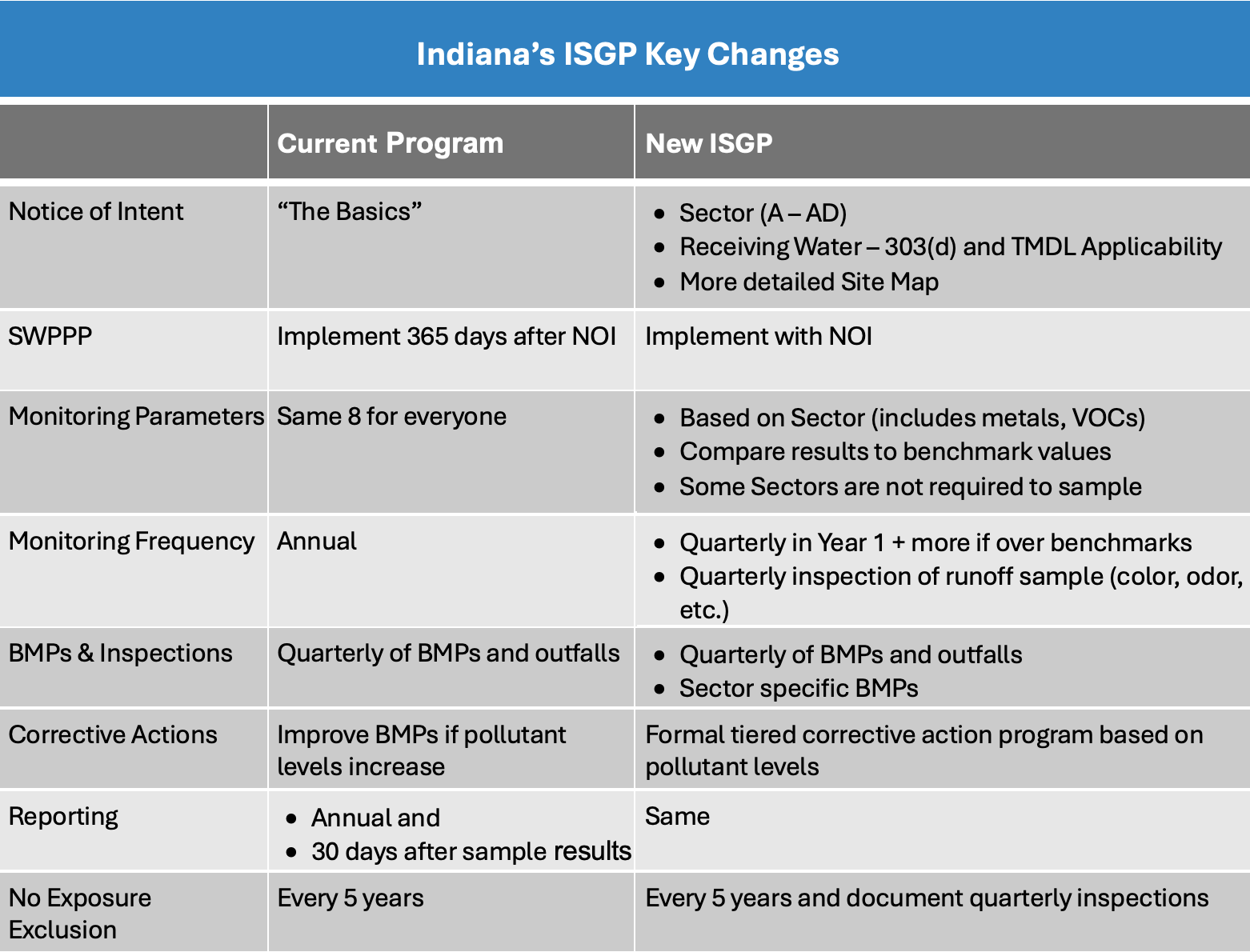
While the types of facilities required to obtain permit coverage will remain the same, the new ISGP introduces more rigorous requirements related to sampling frequency, pollutant benchmarks, inspections, and corrective actions.
Below are several key changes facilities should be aware of.
What additional information is required with the Notice of Intent?
Under the new ISGP, facilities will need to gather additional information prior to submitting a Notice of Intent (NOI) to obtain permit coverage.
Two critical pieces of information include:
Industrial Sector Classification
A facility’s sector is determined by its Standard Industrial Classification (SIC) code, which determines the specific pollutants that must be monitored under the permit. Certain sectors will also be required to implement sector-specific Best Management Practices (BMPs).
Facilities can determine their sector by reviewing Appendix A of the ISGP, which categorizes industries into multiple sectors based on the type of operations conducted.
Receiving Water Classification
Facilities must also determine whether their stormwater discharges to an impaired water body, identified on IDEM’s Section 303(d) list of impaired waters.
If a receiving water is listed as impaired, or if a Total Maximum Daily Load (TMDL) has been established for that water body, additional monitoring or BMP requirements may apply.
Because of these additional requirements, facilities should begin gathering this information early to ensure a smooth NOI submission process.
When does the SWPPP need to be implemented?
Indiana facilities regulated under the current program are already required to develop and implement a Stormwater Pollution Prevention Plan (SWPPP).
A SWPPP outlines the Best Management Practices, inspection procedures, employee training, and operational controls used to minimize pollutants in stormwater runoff.
While many SWPPP requirements remain similar under the new ISGP, one important change affects implementation timing:
Current Rule 6 requirement: Facilities have up to 365 days after submitting the NOI to fully implement their SWPPP.
New ISGP requirement: The SWPPP must already be implemented at the time the NOI is submitted.
This change means facilities will need to complete SWPPP updates before applying for permit coverage, rather than after.
How have monitoring parameters changed?
Under the current Rule 6 program, many facilities monitor a standard set of eight stormwater pollutants, including:
pH
Chemical Oxygen Demand (COD)
Carbonaceous Biochemical Oxygen Demand (CBOD5)
Total Kjeldahl Nitrogen (TKN)
Nitrate + Nitrite
Oil & Grease
Total Suspended Solids (TSS)
Phosphorus
Under the new ISGP, monitoring requirements will be more sector-specific. Some facilities may actually monitor fewer parameters, while others may need to monitor new pollutants such as metals or additional indicators, depending on their SIC Code as listed in Appendix A Sector. Other facilities may not need to perform any sampling.
Examples of benchmarks that may apply to certain facilities, based on their sector, are below.
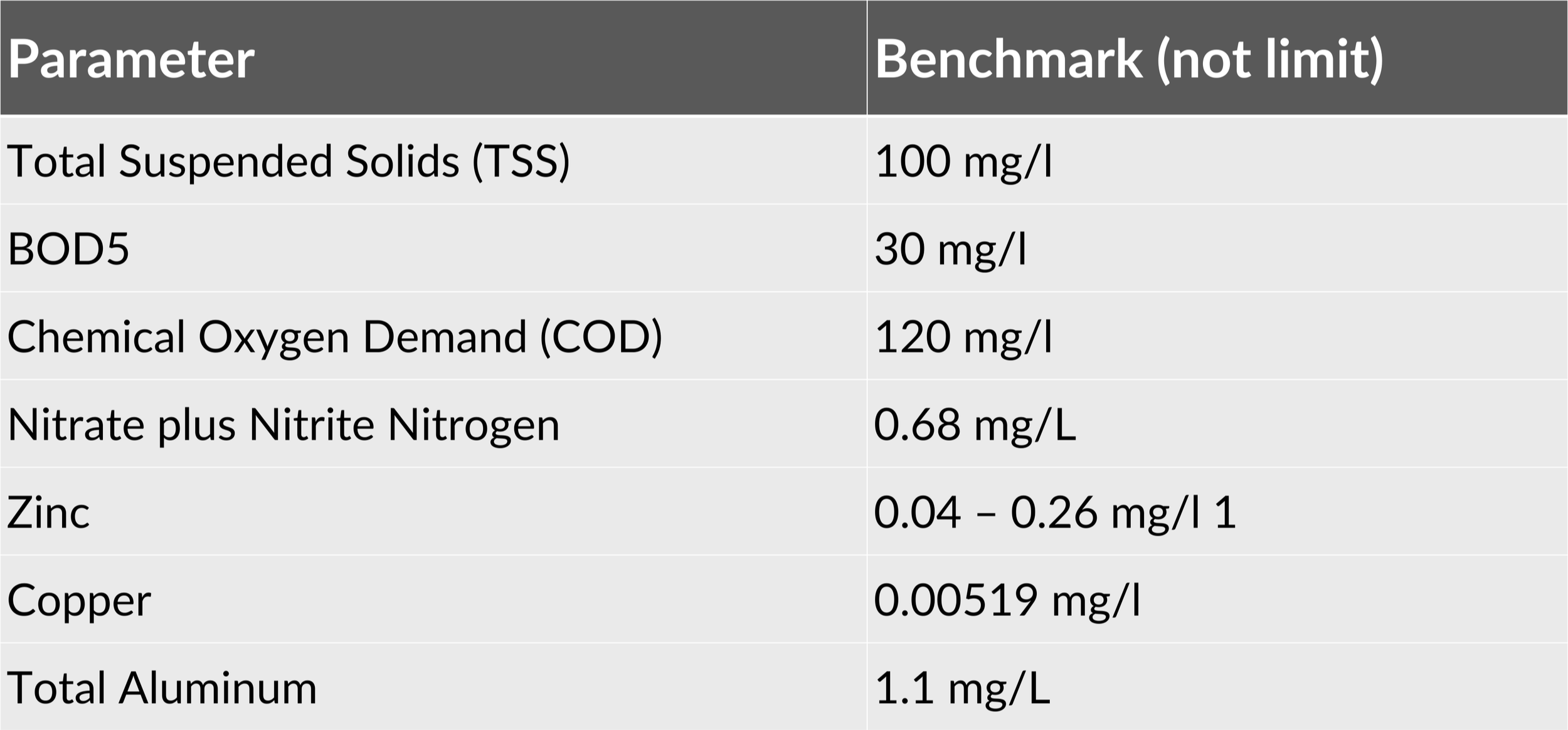
1 – Benchmark is determined by the hardness in the receiving stream. Higher hardness results in a higher benchmark value.
What is the required ISGP monitoring frequency?
Samples for Laboratory Analysis
Facilities must collect four quarterly samples from each outfall during the first eight quarters (two years) of the permit term. After the initial sampling period, future monitoring requirements are determined based on the average of the first four samples collected for each pollutant at each outfall.
The flow chart below illustrates how monitoring frequency is determined under the new permit.
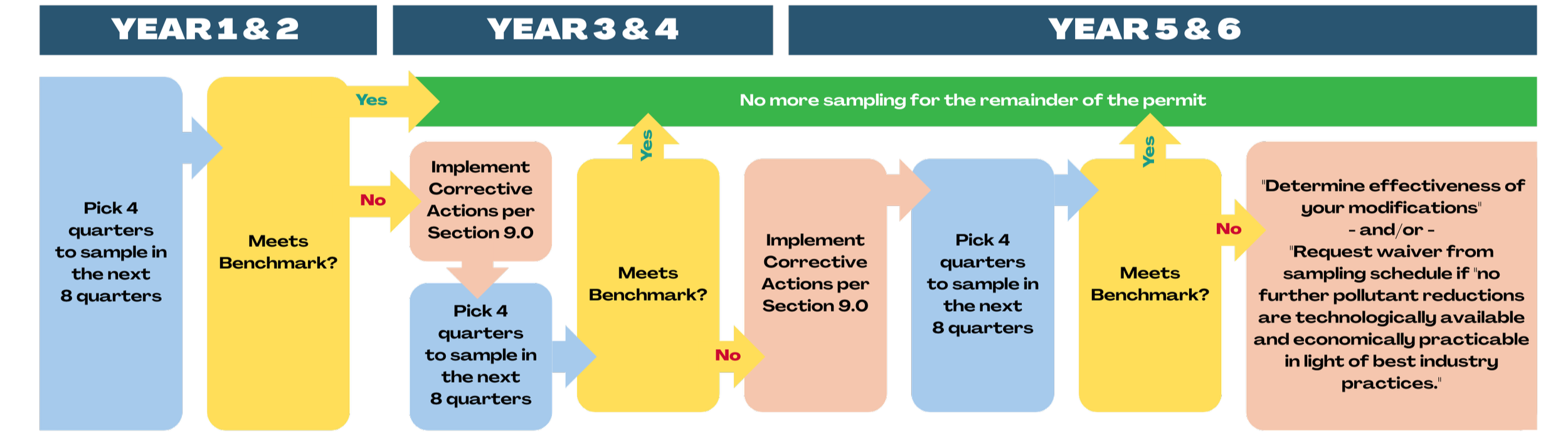
Depending on these results, monitoring requirements may vary:
Some facilities may only be required to collect four samples over the entire five-year permit term.
Others may be required to continue quarterly monitoring for the duration of the permit.
The outfalls, pollutants monitored, and sampling frequency are determined by the concentration levels of each pollutant discharged from each outfall. Monitoring must continue for any pollutant whose average concentration exceeds the applicable benchmark value.
As a result, facilities may need to carefully track multiple variables, including each outfall, each pollutant parameter, benchmark exceedances, and applicable monitoring schedules. Managing these requirements may require more detailed recordkeeping and oversight than under the previous program.
Samples for Visual Inspection
In addition to laboratory monitoring, facilities must conduct quarterly visual inspections of stormwater discharges. These inspections must be documented and include evaluation of the following characteristics in a sample collected from each outfall during a storm event:
(A) Color
(B) Odor
(C) Clarity (diminished)
(D) Floating solids
(E) Foam
(F) Suspended solids
(G) Settled solids
(H) Oil sheen
(I) Other indicators of pollution
Even if laboratory analysis is not required every quarter for the entire permit term, facilities should plan to collect stormwater samples from each outfall during qualifying storm events every quarter in order to perform the required visual inspections.
What sector-specific BMPs are required under the new ISGP?
Facilities currently permitted under Indiana’s industrial stormwater program already maintain SWPPPs that include site-specific BMPs designed to address the unique stormwater risks associated with their operations. For example, a facility may implement a BMP requiring that all drums be stored under cover in a designated storage yard to prevent exposure to stormwater.
Under the new ISGP, some facilities will also be required to implement sector-specific BMPs in addition to their site-specific controls. These additional requirements are based on the facility’s industrial sector and are intended to address common stormwater risks associated with certain types of operations.
For example, facilities in the Transportation and Warehousing sector that conduct vehicle maintenance or equipment cleaning must implement BMPs such as:
(a) Minimize the potential for stormwater exposure to leaky or leak-prone vehicles or equipment awaiting maintenance.
(b) Minimize contamination of stormwater run-off from fueling areas.
(c) Maintain all material storage vessels (e.g., for used oil/oil filters, spent solvents, paint wastes, hydraulic fluids) to prevent contamination of stormwater and plainly label them (e.g., “Used Oil,” “Spent Solvents,” etc.
(d) Minimize contamination of stormwater run-off from all areas used for vehicle or equipment cleaning or maintenance.
(e) Minimize stormwater run-on and run-off or utilize appropriate sediment control measures to minimize the off-site transport of sanding material associated with locomotive sanding areas.
(f) Inspect all areas/activities associated with storage areas for vehicles or equipment awaiting maintenance, fueling areas, indoor and outdoor vehicle and equipment maintenance areas, material storage areas, vehicle and equipment cleaning areas, and loading/unloading areas.
While many facilities may already have similar controls in place, the new ISGP provides more detailed expectations and clearer standards for both permittees and agency inspectors.
Are there additional requirements for inspections?
The new ISGP also provides more specific guidance regarding inspection procedures and recordkeeping requirements.
Both the current rule and the new ISGP require quarterly inspections of BMPs, areas of industrial activity, structural controls, and other stormwater control measures. However, the new permit adds an additional requirement that at least one of the quarterly inspections must occur during a stormwater discharge event, when runoff is actively leaving the site.
In addition, as discussed in the Monitoring Frequency section, facilities must collect a stormwater sample from each outfall on a quarterly basis for visual inspection.
These expanded inspection and documentation requirements are intended to help facilities identify potential sources of stormwater contamination more quickly and ensure that BMPs are functioning as intended.
What is the corrective action timeline under the new ISGP?
The ISGP establishes a formal corrective action process that facilities must follow when certain conditions are identified. Documentation of all corrective actions must be maintained at the facility and will likely be reviewed during IDEM inspections.
Several situations may trigger the corrective action process. The most common triggers include issues identified during quarterly inspections and stormwater monitoring results that exceed benchmark values.
When a corrective action is required, the ISGP outlines a specific timeline for addressing the issue:
Take immediate action to minimize or prevent further discharge of pollutants.
Document and report the corrective action within 24 hours of becoming aware of the condition.
Initiate corrective actions within 14 days of identifying the issue.
Complete corrective actions within 45 days, unless additional time is justified.
Update the Stormwater Pollution Prevention Plan (SWPPP) within 90 days, if necessary, to reflect operational or procedural changes.

The corrective action report must include detailed documentation, such as the date the condition was discovered, the location of the issue, the actions taken to correct it, the schedule for completion, and an evaluation of whether similar conditions may exist elsewhere at the facility to prevent similar occurrences.
Many facilities are already familiar with corrective action processes as part of their environmental management or operational programs. However, the ISGP introduces more specific documentation requirements and timelines, which may require facilities to make adjustments to their existing procedures to ensure compliance.
How will annual reporting change under the ISGP?
Annual reports are currently required and will continue to be required under the ISGP. The overall structure of the report will remain similar to current requirements; however, the information reported, such as data on inspections, monitoring results, receiving waters, and corrective actions, will reflect the updated requirements described above.
How should my facility prepare for the new ISGP?
The new permit is expected to significantly change how facilities manage their industrial stormwater programs. There are several steps current permittees can take now to prepare for the transition to the ISGP.
A suggested “to-do” list is provided below:
Determine which industrial sector your facility falls under
Identify which benchmark parameters apply to your operations
Conduct sampling if data is not available and compare results to applicable benchmarks
Establish a sampling schedule with your laboratory
Evaluate potential sources of pollutants at your facility
Update your Stormwater Pollution Prevention Plan (SWPPP)
Determine whether your facility discharges to an impaired water
Participate in public meetings or informational forums related to the new permit
Current permittees will be required to transition to the new permit within 180 days of receiving IDEM's notification that their facility is due to transition.
Some of the most significant changes affecting permit compliance may include:
Meeting the NOI deadline and submitting the Notice of Intent on time
Increased sampling frequency
Changes to monitoring parameters
Updates to the SWPPP program requirements
Changes to inspection procedures
Updates to the corrective action program
Implementing additional requirements for discharges to impaired waters
IDEM is currently revising the NOI process and application form. Until that process is finalized, both current and new permittees should continue to follow the existing Rule 6 permit procedures.
For many facilities, the new ISGP will introduce additional monitoring, documentation, and operational requirements compared to the previous Rule 6 program. Understanding how these changes apply to your specific operations, such as sector classification, benchmark parameters, and receiving water conditions, will be important for maintaining compliance. Facilities that begin evaluating their stormwater programs now will be better positioned to transition smoothly once IDEM begins implementing the new permit requirements.
If you would like to discuss how the new ISGP may impact your facility, contact us or call (800) 508-8034 to speak with one of our stormwater professionals.
Author

Kristen Belcredi, P.E., C.H.M.M., ISO Auditor
Senior Vice President, Air & Engineering Services
KERAMIDA Inc.
Contact Kristen at kgb@keramida.com
Related Services:



