
Get the Most Out of Your Energy Audit: Better Savings, Better Data, Better Decisions
/
According to the U.S. Department of Energy, an average of 30% of energy used in commercial buildings is wasted. For most organizations, that inefficiency is invisible, showing up on the utility bill without revealing where the energy is being wasted or what can be done about it. A commercial energy audit can change that.
For building owners, facility operators, municipalities, manufacturers, and institutions, a well-executed energy audit delivers three measurable benefits:
Quantified energy savings and financial metrics to build the business case
Facility-specific data to quantify potential GHG reductions
Operational insights that inform capital planning, maintenance, and investment decisions
This article focuses on how organizations can maximize the value of an energy audit and put the findings to use. For a detailed walkthrough of the ASHRAE audit process, including site-visit procedures, measurement protocols, and calculation methodologies, see our companion article: The Best Approach for Commercial Energy Audits.
Choose the Right ASHRAE Energy Audit Level
Not all energy audits are the same. The American Society of Heating, Refrigerating, and Air-Conditioning Engineers (ASHRAE) 211-2018 Standard for Commercial Building Energy Audits defines three audit levels. The right level depends on what decisions you need to make and how much financial certainty those decisions require.
Where are we wasting energy?
ASHRAE Level 1
Walk-Through Analysis
Which projects are worth pursuing?
ASHRAE Level 2
Energy Survey and Analysis
What will the investment really deliver?
ASHRAE Level 3
Detailed Analysis of Capital-Intensive Modifications
Where an Energy Audit Finds Savings
Energy audits identify savings opportunities across electricity, natural gas, steam, compressed air, process energy, and other utility expenses. Opportunities typically fall into two tiers: No-cost/Low-cost and Capital Projects.
Common examples include:
No-cost/Low-cost: HVAC scheduling, setpoint corrections, lighting conversion, air sealing
Capital Projects: Equipment replacement, roof and wall insulation, window replacement
The savings identified through an energy audit often more than offset the cost of the audit itself once recommended measures are implemented. This is especially true for facilities with high utility bills, aging equipment, long operating hours, or limited visibility into energy performance.
The U.S. Department of Energy’s Industrial Training and Assessment Centers report average savings of $141,400 per assessed site, across more than 21,650 manufacturers and more than 161,200 recommendations developed through the program.
The U.S. EPA’s ENERGY STAR program helped commercial buildings and industrial plants avoid $14 billion in energy costs, save 230 billion kWh of electricity, and reduce 170 million metric tons of emissions in 2023. Since 1992, ENERGY STAR has helped organizations avoid nearly $200 billion in energy costs.
Key Financial Metrics in an Energy Audit Report
A strong energy audit report equips decision-makers to compare options and build an internal business case. Level 2 audits provide financial metrics based on engineering estimates and industry-averaged costs. Level 3 audits refine these using actual contractor quotes and manufacturer pricing.
Simple Payback estimates the number of years it takes for annual savings to recoup the upfront investment. For example, if a lighting upgrade costs $50,000 and saves $25,000 per year, the simple payback is two years. This metric is easy to communicate and useful for initial screening, but it does not account for the time value of money or savings that continue beyond the payback period.
Savings-to-Investment Ratio (SIR) is the ratio of present value savings to present value costs for an energy or water conservation measure. An SIR greater than 1.0 indicates that the measure is expected to save more than it costs over the analysis period. For example, a project with $120,000 in present-value savings against $80,000 in costs has an SIR of 1.5. This metric is especially useful when comparing multiple capital projects because it accounts for life-cycle value rather than first cost alone.
How an Energy Audit Identifies GHG Reductions
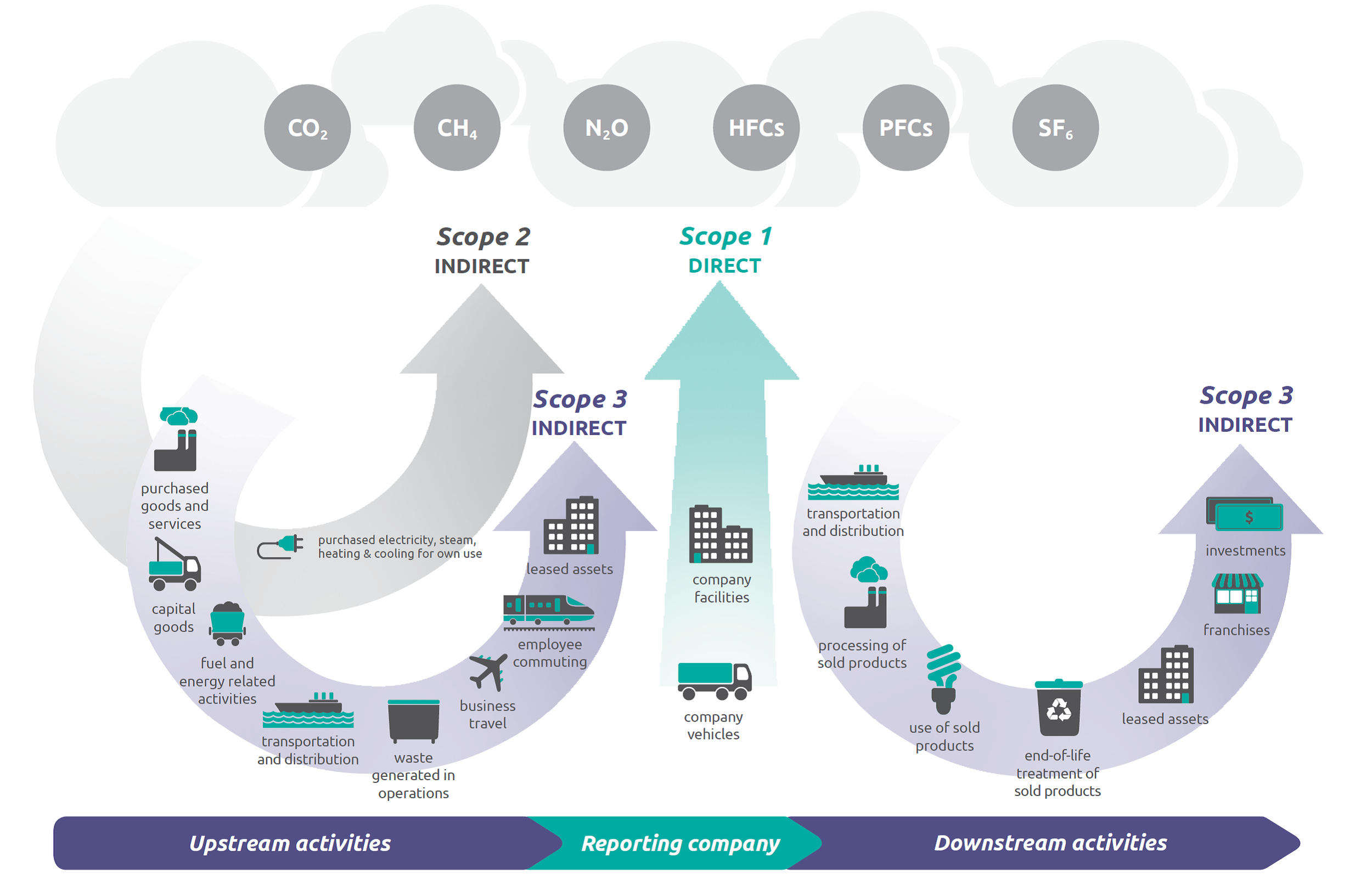
Energy efficiency is often one of the most practical and cost-effective ways to reduce operational GHG emissions. According to UNEP’s 2024/2025 Global Status Report for Buildings and Construction, the buildings and construction sector alone consumes 32% of global energy and contributes 34% of global CO₂ emissions as of 2023. Identifying and reducing energy waste can therefore be an important step toward meeting organizational GHG reduction goals.
For organizations with Scope 1 and Scope 2 reduction goals, whether driven by net-zero commitments, ESG reporting requirements, voluntary disclosure frameworks, or emerging regulatory requirements, an energy audit provides facility-specific, quantified data for evaluating potential reductions.
Facilities can reduce Scope 1 emissions (direct emissions) by improving the efficiency of on-site combustion equipment such as boilers, furnaces, and heaters that consume natural gas or other fuels. Scope 2 emissions (indirect emissions from purchased energy) can be reduced by lowering electricity and steam consumption through equipment upgrades, controls optimization, and operational changes.
Translating Energy Savings into CO₂e Reductions
During the audit, engineers calculate projected energy savings for each ECM in kilowatt-hours (kWh) for electricity and therms for natural gas. Those savings are then converted into GHG reductions using emissions factors from regulatory agencies such as the U.S. EPA or the U.K. Department for Energy Security and Net Zero (DESNZ, formerly DEFRA). The result is a facility-specific estimate of metric tons of CO₂ equivalent (CO₂e) avoided per measure.
This measure-by-measure GHG data gives facility and sustainability teams a clear picture they can use to:
Prioritize projects by emissions impact alongside cost and payback
Set facility-level reduction targets grounded in engineering data
Track progress against net-zero or science-based targets over time
Report to leadership, boards, or disclosure frameworks such as CDP, GRI, and IFRS S2
What an Energy Audit Reveals About Your Facility
Beyond direct savings and GHG reductions, commercial energy audits can uncover information that improves capital planning, maintenance prioritization, and day-to-day facility decisions. For many facilities, this is where the most immediately actionable value lies.
Equipment Inventory Baseline
Many facilities lack a centralized, up-to-date record of HVAC units, boilers, chillers, motors, pumps, lighting systems, controls, and other energy-consuming assets. An audit documents what equipment exists, how it is operating, and where replacement or optimization is needed, giving facility managers a reliable baseline for long-term planning.
Early Identification of Maintenance Issues
During a site walkthrough, auditors frequently identify malfunctioning dampers, simultaneous heating and cooling, compressed-air leaks, failed sensors, dirty coils, outdated control schedules, leaking valves, and equipment operating outside intended parameters. These are costs that accumulate quietly and often go undetected without a systematic review.
Structured Capital Planning
Rather than replacing equipment only when it fails, organizations can use audit findings to prioritize upgrades based on cost, savings potential, emissions reductions, remaining useful life, and operational risk. This aligns maintenance budgets with sustainability goals, resilience needs, and long-term asset management strategies.
Preparing for Building Performance Requirements
For facilities subject to benchmarking mandates or building performance standards (BPS), an energy audit can help identify the improvements needed to meet performance requirements. Audit findings can be used to evaluate compliance pathways, estimate potential penalties, and prioritize capital projects based on their energy and emissions impact.
Stakeholder Alignment
A clear audit report gives leadership, finance teams, facility managers, and sustainability staff a shared set of metrics to work from: estimated cost, annual savings, GHG reductions, payback, SIR, operational impacts, and implementation priority. This common frame is particularly valuable when seeking budget approval or board-level sign-off on capital projects.
Energy Audits Are a Foundation for Action
An energy audit is only as valuable as what an organization does with the findings. The greatest return comes from using the data to prioritize opportunities, make informed investments, and turn identified energy savings and GHG reductions into measurable results. Instead of guessing where energy dollars are going or which upgrades will have the greatest impact, an energy audit becomes a tool to improve both financial and environmental performance.
Beyond identifying immediate improvements, an energy audit can also lay the foundation for a long-term energy management program. The baseline data, significant energy uses, and ECMs identified during the audit are the same building blocks needed to establish an ongoing energy management program, such as one aligned with ISO 50001 – Energy Management Systems (EnMS). For organizations looking to build on their results, an energy audit can serve as the first step toward continuous energy improvement.
KERAMIDA’s energy audit experts help public, commercial, multifamily, municipal, and industrial clients identify practical energy-saving opportunities, quantify GHG reductions, and develop implementation-ready recommendations that support both sustainability and profitability.
Contact KERAMIDA today to discuss your facility’s energy audit needs.
Author

Steve Loria, CEM, LEED AP BD+C, ENV SP
Manager, Sustainability Strategy & Reporting
KERAMIDA Inc.
Contact Steve at sloria@keramida.com
Related Services

Whether you manage a single building or an entire portfolio, KERAMIDA’s energy audit experts deliver insights that translate into measurable energy and cost savings. Led by our Certified Energy Manager (CEM), our team of engineers and green building experts has decades of combined experience working on significant energy audit projects. Our ASHRAE-compliant energy audits are tailored to each facility.